Damming Mexico
Dams come in various shapes and sizes, but all are constructed with the goal of stopping or impeding the water flow of rivers and streams. Dams may be used to contain water, generate hydroelectricity, and prevent flooding, among other uses. A great deal of controversy surrounds these projects, and the criticisms vary. Some critics completely oppose all dams. Other critics oppose large dam projects, but not small dams, believing dams should be built only after the public receives all pertinent project information.[1] In general, however, critics across the ranks accept that large dams cause enormous irreversible damage across economic, health, environmental, and social fronts.
The international community has taken measures to mitigate such damage through the founding of the World Commission on Dams. An international panel founded to provide the first comprehensive evaluation of dams, this commission examines the benefits, effects, and feasibility of dams. Part of the commission’s work included creating a set of dam construction guidelines for governments to follow. These guidelines are designed to protect affected communities, ensuring their ability to negotiate compensation packages as well as be the primary beneficiaries of a dam project.[2] When a dam is planned according to these guidelines, the government can mitigate some of the damages that could otherwise occur. These guidelines, however, are usually costly and time-consuming, resulting in non-compliance as the norm, rather than the exception.[3]
Mexico is hardly exempt from this trend. According to the Instituto Nacional de Estadística y Geografía (National Institute of Statistics and Geography) (INEGI), there are more than 50 “main dams” throughout the country of Mexico.[4] This count does not include the medium and small dams populating the country. With just one of these large dams, the effects rendered are severe and widespread. With more than 50, the effects are accordingly multiplied.
Why Dams Sell
Governments and companies claim various benefits of dams, both direct and indirect. Direct uses include: (i) domestic use (household purposes, drinking water); (ii) commercial use (restaurants, hotels); (iii) irrigation for crops; (iv) raising of livestock; (v) industrial use (cooling and processing water); (vi) mining; and (vii) general public supply (firefighting, public parks, municipal office buildings).[5] Indirect uses include: (i) hydroelectric power; (ii) flood control; and (iii) transportation.[6]
Why Dams Damage
A whole slew of effects emanate from a dam’s presence, particularly a large dam. These include economic, health, environmental, and social effects.
Economic Effects
A study conducted by the World Commission on Dams shows that large dams are, at best, only marginally economically viable, given that the average cost overrun of dams is around 56%.[7] Put into numbers, that means a dam estimated to cost $1 billion actually costs $1.56 billion. The Commission also found that a country’s citizens are the ones who actually shoulder a dam’s economic costs, namely its construction and maintenance.[8] While the citizens bear this financial burden, the actual project builders earn both a profit and a new project to show off for their efforts.[9]
For many countries with few economic resources, dams represent the country’s largest energy development investment. This leads to an unbalanced supply of energy.[10] Normally, as a country’s use of “modern” forms of energy increases, so too do its economic resources – this trend is reversed, however, for countries dependent on hydroelectricity.[11] Of the 40 countries in the world with the most economic resources, only one is more than 90% dependent on hydroelectricity.[12] In comparison, of the 40 countries in the world with the fewest economic resources, fifteen are more than 90% dependent on hydroelectricity.[13]
This imbalance between what a country invests and what a country gains produces a significant economic loss for citizens in countries invested in large dam projects. The project builders are the ones who gain, the country’s citizens are the ones who lose.
Health Effects
A dam’s presence also carries with it the risk various diseases. When a dam is built, it requires the construction of an artificial lake called the reservoir. The reservoir lies behind the dam wall, and is formed by flooding the river valley behind where the wall is placed. As the reservoir halts the flow of running water, it converts the water into a standing, increasingly stagnant body of water. It is in this environment of increasingly stagnant water that diseases such as dysentery, cholera, and hepatitis A are formed and spread.[14] Additionally, because this formally running water has now been converted to standing water, it allows insects to breed (i.e. mosquitoes), which carry diseases such as malaria and schistosomiasis.[15]
Further health concerns include the increase in toxic chemicals and the accumulation of mercury in the water contained in the reservoir, water that is then occasionally released downstream. These threats will be discussed under the “Environmental Effects” section below.
Environmental Effects
Dams also lead to extensive environmental damage. Habitat destruction often occurs for a number of reasons when a dam is built. Raw materials are needed during the actual construction of the dam. This need results in the creation of nearby quarries and borrow pits, from which the required rock and raw materials are extracted for construction.[16] Furthermore, when the river valley is flooded to form the reservoir, this flooding destroys the natural habitat previously present.[17] Once the reservoir exists, this stagnant body of water tends to accumulate floating aquatic vegetation that degrades the water present in the reservoir.[18] This leads to the deterioration of aquatic habitats, provides breeding grounds for insects, and increases water loss from some dams.[19] After a dam is built, human access to the region usually improves, leading to an increase of further projects. New access roads to the dam can lead to deforestation, loss of biodiversity, and accelerated erosion.[20] Power transmission lines reduce and divide forests, further facilitating deforestation.[21] Associated projects also often develop with the introduction of irrigation projects, urban expansion, and industrial facilities.[22] Furthermore, once one dam is built on a river, this makes constructing a second dam more economical.[23] Any one of these factors can lead to major habitat destruction – taken in the aggregate, the probability of habitat destruction only multiplies.
Dams inevitably result in a loss of wildlife. During the flooding process when creating the reservoir, both local and global extinction of plants and animals may occur due to the permanent inundation of these habitats.[24] Animals may also drown during the flooding process, resulting in further wildlife loss.[25] After the dam is built, this often blocks the upriver migratory path of certain fish, meaning they cannot reach their spawning grounds to reproduce.[26] Of the animals that remain in the artificial lake created by the reservoir, many are river-adapted species incapable of surviving in their new environment.[27] Furthermore, as the water both in and below the reservoir loses oxygen (to be explained below), this results in the death of aquatic life and damage to aquatic habitats.[28]
By force, natural flood patterns change upon a dam’s construction. Seasonal flooding clears out blocked waterways, preventing larger, subsequent floods from causing huge amounts of damage.[29] Without seasonal flooding, these passages remain blocked. Natural floods also carry nutrient-rich sediments downstream, nourishing the ecosystems along the river’s path.[30] Traditional farming systems often depend on and have adapted to this natural cycle.[31] When this natural flooding comes to a halt, so too does the process of depositing this nutrient-rich sediment downstream, in turn affecting both ecosystems and flood-reliant farming systems.
A dam further produces extensive amounts of greenhouses gases. When a reservoir is constructed, it floods a river valley where vegetation had been growing. If the forest in the river valley is cut and burned before the reservoir filling, these greenhouses gases may be produced quickly.[32] If the vegetation is left to rot and decay underneath the filled reservoir, these greenhouse gases may be produced slowly.[33] In certain cases, these greenhouses gases impact global warming worse than if fossil fuels generated the same amount of power generated by the dam.[34] Because clearing vegetation when constructing a reservoir is usually both difficult and costly, it is only partially done at best.[35]
There is also a tentative correlation between the creation of a large reservoir and an increase in the seismic activity in the region.[36] The reservoir may not directly cause an earthquake, but the reservoir’s weight may help trigger seismic activity.[37] This seismic activity, in turn, can threaten dam stability and the safety of people living downstream of the reservoir.[38]
Perhaps the most complicated environmental effect caused by dams is the deterioration of water quality. The deterioration of water quality includes a variety of effects, such as: (i) a stagnant water table; (ii) increased salinity; (iii) a dramatic change in water temperature; (iv) de-oxygenation; (v) an increase in toxic chemicals; (vi) the accumulation of mercury; and (vii) heavy sedimentation.
The existence of a dam often leads to a stagnant water table. Once the reservoir is filled, thereby creating an artificial lake, the water from the reservoir may seep down into the water table; this can overload the natural water table and slow down its flow.[39] As a result, the water table may ultimately go stale, harming both the plant life nearby and the well water of locals.[40]
A dam also increases a river’s salinity. Because the reservoir forms a large body of standing water, this multiplies the surface area of water exposed to the sun. In turn, this increases the amount of water that evaporates from the river-turned-lake.[41] As the water evaporates from the reservoir, the amount of water available to the river downstream decreases.[42] The continued evaporation drains the system of water while leaving behind the salt, leading to harmful salinity levels in the water.[43] High concentrations of salt harm aquatic life, but may also be so high that they corrode pipes and machinery.[44]
As the reservoir lays bare below the sun, it leads to a dramatic change in water temperature. This standing water with a large surface area is now increasingly exposed to the sun, allowing the reservoir to heat up. In comparison, a running body of water would not be susceptible to such exposure.[45] The aquatic life that still exists in the reservoir perishes due to this temperature change, resulting in a further loss of species.[46]
De-oxygenation also occurs when a reservoir forms. The water becomes de-oxygenated both due to a change in temperature and due to an increased nutrient content caused by algae. In the reservoir itself, the water temperature is layered, differing in temperature from the river below the dam.[47] During the summer, the water released from the reservoir is usually cooler than the downstream river water; during the winter, the reservoir water is warmer than that downstream.[48] Because of the temperature difference between the released water and the downstream river, the river warms or cools, thereby affecting the amount of dissolved oxygen and suspended solids present in the river. This, in turn, impacts the river’s chemical reactions, reducing the water’s oxygen content.[49] An increase of algae, brought about by the stagnant nature of the water, also leads to the reservoir’s de-oxygenation. During warm weather, the algae proliferates, resulting in a “eutrophic” reservoir, meaning one that is rich in nutrients and plant life.[50] Through photosynthesis, the algae consume the nutrients naturally present in the reservoir water.[51] The living algae create numerous problems, including a rather nasty smell and taste to the water, clogged water supply intakes, coated gravel beds, and restricted recreation.[52] The dead algae sink to the bottom of the reservoir and rot, using what oxygen is left at the reservoir’s bottom in the decaying process.[53] Hence, through both temperature change and an increase in algae, the reservoir becomes an oxygen-depleted body of water.
After the water has been deprived of oxygen, this increases the toxic chemicals present in the water. Oxygen-deprived water is highly acidic, meaning the water can now dissolve minerals in the soil, such as iron and manganese.[54] As water is released downstream, the water that now flows from the reservoir to enter the river is usually cold, de-oxygenated, high in nutrients (due to a high algae content), and filled with potentially harmful mineral concentrations.[55]
A de-oxygenated reservoir also provides the conditions needed for the formation of poisonous methyl-mercury, a central nervous system toxin.[56] Soil naturally contains mercury, but in a harmless inorganic form.[57] The increased amount of rotting vegetation under the reservoir, however, leads to an increased amount of bacteria consuming the decaying matter. The higher level of bacteria leads to an increased transformation of this mercury into methyl-mercury.[58] Life forms at the bottom of the food chain, such as plankton, consume this methyl-mercury. Animals higher up the food chain, such as small fish, accumulate methyl-mercury as they eat contaminated prey. Larger fish then eat the smaller fish, further accumulating methyl-mercury in their bodies. Through bioaccumulation, the larger fish in the reservoir food chain contain levels of methyl-mercury much higher than the levels of methyl-mercury in the smaller organisms. Thus, when these contaminated, larger fish land in the hands of a person living nearby, the levels of methyl-mercury in this person’s body also increase upon eating the contaminated fish.[59]
A dam also causes a change in sedimentation. In a running river, the river washes sediments downstream.[60] When a dam is built, the sediment stops at the wall of the dam.[61] Sediment accumulation in the reservoir reduces the efficiency of the dam, meaning that a dam on a river with a high sediment load has a relatively short life span.[62] Over time, this means that the energy produced by the dam is not renewable.[63] Changes in sedimentation also cause river erosion. As the dam holds back sediments that would normally flow downstream, the river recaptures this lost sediment by eroding the riverbed and banks below the dam.[64] This erosion usually extends several meters downstream, but can extend up to hundreds of kilometers below a dam.[65] As the downstream riverbed is eroded, the groundwater table along the river also lowers, meaning vegetation and local wells no longer have access to water beneath the soil. Accordingly, irrigation becomes a necessity where it was previously not needed.[66]
Social Effects
Perhaps the most troubling effect of large dam projects is the involuntary displacement and forced resettlement of residents around the dam. When a dam is constructed, the reservoir is formed by flooding the river valley behind the dam wall. Prior to flooding this area, all the people living in the region must be evacuated and relocated. Essentially, the dam’s construction forms a refugee population.
A great inequality also exists in terms of who benefits and who suffers when a dam is constructed. The people living in urban centers far removed from the dam are usually the group that receives a dam’s benefits.[67] Those who suffer the most are almost invariably campesinos (peasant farmers) and indigenous persons.[68] Very often, the cost of being uprooted is placed on the people being moved.[69] Because societies usually marginalize the campesino and indigenous populations, the burden of displacement is that much heavier on these groups, leaving them poorer than before.[70] This is especially true for farmers transplanted into an urban area, an existence for which they often lack skills when seeking a livelihood.[71] Displacement and resettlement regularly bring about severe psychological stress on the people affected.[72] Host communities accepting the refugees similarly suffer a strain when seeking to integrate the new arrivals.[73]
Loss of land occurs as a dam is built. When the river valley is flooded to form the dam, the property that existed on the site is completely destroyed.[74] Additionally, when people relocate to lands that are not cleared, this creates new environmental concerns as land is converted to host resettled populations.[75]
Loss of culture results when communities are resettled. For many people, the transition from a rural to an urban culture often destroys the traditional lifestyles that were tied up in the land where they lived.[76] The river valley’s flooding for the reservoir also causes a loss of cultural property. Inundating the land often covers up archaeological, historical, paleontological, and religious sites and objects.[77] Not only does this signify the loss of the tangible item or land, it also extinguishes the cultural practices tied to the physical object or piece of land.
From a legal standpoint, the most troubling element of dam construction is the routine lack of consultation and participatory decision-making that occurs during resettlement. In Mexico, the government is obligated to consult and involve the affected peoples in the decision-making process. This obligation is enshrined both in international law under the ILO Convention 169, as well as under domestic law stemming from the Mexican Constitution. Yet these obligations are rarely fulfilled, resulting populations transplanted without their consent or participation.[78]
Broken promises are another common component of dam projects. Communities frequently receive promises of projects to help the community, ranging from improved irrigation and new schools to medical clinics.[79] Yet governments rarely fulfill these promises. Governments and companies also promise compensation for those who are displaced by the dam. This compensation, however, rarely comes – and when it does come, it is usually woefully inadequate.[80]
Apart from the displaced communities, the downstream residents also experience backlashes from the dam. As the reservoir fills with water, the river downstream often substantially dries up, denying the people along the river both water and the fish previously present.[81] Additionally, after the dam is filled, the water released incrementally by the dam is nearly devoid of oxygen. Because fish need oxygenated water to survive, the fish further downstream perish.[82] De-oxygenated water prevents the reestablishment of the fish population for some distance down the river, depriving the people living in the area of a vital food source.[83]
Understanding the Disconnect
There is a vast gap between the estimated benefits and the actual benefits that flow from a dam. The decision-making process when beginning new dam projects tends to vastly underestimate the social and environmental impacts of the future project.[84] At the same time, this process tends to overestimate the benefits to be reaped from the dams.[85]
Above all, a fundamental problem remains with the entire process of building these dams. In general, federal governments and companies lack a vested concern in local interests.[86] This results in a situation permitting governments and companies to construct a project, claim progress, and close their eyes to the damage done. It is only once the affected communities begin to protest, invoking their rights under the law, that these dams and the effects they cause come to a standstill.
(To be continued with the case study of Huitiupan…)
[1] International Rivers, “About Dams,” http://www.internationalrivers.org/en/node/287, accessed March 28, 2011.
[4] Instituto Nacional de Estadística y Geografía (INEGI), “Medio Ambiente: Agua: Presas,” http://www.inegi.org.mx/Sistemas/temasV2/Default.aspx?s=est&c=21385, accessed March 28, 2011.
[5] Devencenzi, Tony. The Environmental and Social Impacts of Large Scale Dams. San Francisco State University, Urban Studies Program, Race, Poverty and the Environment class, supervised by Prof. Raquel R. Pinderhughes. Spring 2003.
[7] International Rivers, http://www.internationalrivers.org/en/node/287.
[14] Leder, George and Juan David Quintero. Good Dams and Bad Dams: Environmental Criteria for Site Selection of Hydroelectric Projects. Latin America and Caribbean Region Sustainable Development Working Paper 16. The World Bank. November 2003.
[17] La Puebla, Ferdinand Leal. Environmental, Social, and Health Effects of Dams in the East Asian Region. Asia Pacific Initiative for Sustainable Development. Masters of Media and Governance, Keio University.
[18] Leder, George and Juan David Quintero, Good Dams and Bad Dams: Environmental Criteria for Site Selection of Hydroelectric Projects.
[24] Leder, George and Juan David Quintero, Good Dams and Bad Dams: Environmental Criteria for Site Selection of Hydroelectric Projects.
[29] Devencenzi, Tony. The Environmental and Social Impacts of Large Scale Dams.
[32] Leder, George and Juan David Quintero, Good Dams and Bad Dams: Environmental Criteria for Site Selection of Hydroelectric Projects.
[33] La Puebla, Ferdinand Leal. Environmental, Social, and Health Effects of Dams in the East Asian Region.
[34] Fearnside, Philip M. Social and Environmental Effects of Hydroelectric Dams in Brazilian Amazonia. Ed. D. Gawora. National Institute for Research in Amazonia (INPA), 1999.
[35] International Rivers, http://www.internationalrivers.org/en/node/287.
[36] Devencenzi, Tony. The Environmental and Social Impacts of Large Scale Dams.
[41] International Rivers, http://www.internationalrivers.org/en/node/287.
[45] Devencenzi, Tony. The Environmental and Social Impacts of Large Scale Dams.
[47] International Rivers, http://www.internationalrivers.org/en/node/287.
[60] Devencenzi, Tony. The Environmental and Social Impacts of Large Scale Dams.
[64] International Rivers, http://www.internationalrivers.org/en/node/287.
[67] Fearnside, Philip M. Social and Environmental Effects of Hydroelectric Dams in Brazilian Amazonia.
[68] International Rivers, http://www.internationalrivers.org/en/node/287.
[69] Devencenzi, Tony. The Environmental and Social Impacts of Large Scale Dams.
[72] La Puebla, Ferdinand Leal. Environmental, Social, and Health Effects of Dams in the East Asian Region.
[73] Devencenzi, Tony. The Environmental and Social Impacts of Large Scale Dams.
[75] Leder, George and Juan David Quintero, Good Dams and Bad Dams: Environmental Criteria for Site Selection of Hydroelectric Projects.
[76] Devencenzi, Tony. The Environmental and Social Impacts of Large Scale Dams.
[77] Leder, George and Juan David Quintero, Good Dams and Bad Dams: Environmental Criteria for Site Selection of Hydroelectric Projects.
[79] Uyigue, Etiosa. The Efficiency and Impacts of Dams: A Case Study of the Challawa Gorge Dam. Society for Water and Public Health Protection. Benin City, Nigeria.
[80] International Rivers, http://www.internationalrivers.org/en/node/287.
[81] Fearnside, Philip M. Social and Environmental Effects of Hydroelectric Dams in Brazilian Amazonia.
[86] Devencenzi, Tony. The Environmental and Social Impacts of Large Scale Dams.
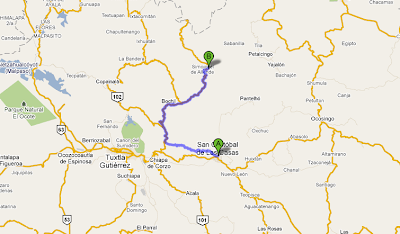 With the previous post in mind discussing the effects of large dam projects, a case study of a community in resistance is now appropriate to contextualize the social struggle against dams. Hence, a look at the municipality of Huitiupan (point B), located roughly four hours from San Cristóbal de las Casas (point A).


